

How much does a kintsugi restoration usually cost?
A short answer it usually starts in:
$150 USD and can go up.
A complete answer: It depends
Depends on the type of fracture (Is it completely broken? just chipped? is it a big piece to repair? does it need some complete reconstruction ?)
Depends on the material of your piece to restore
On the experience and expertise of the artist that will repair the ceramic has
And the materials used to repair it!
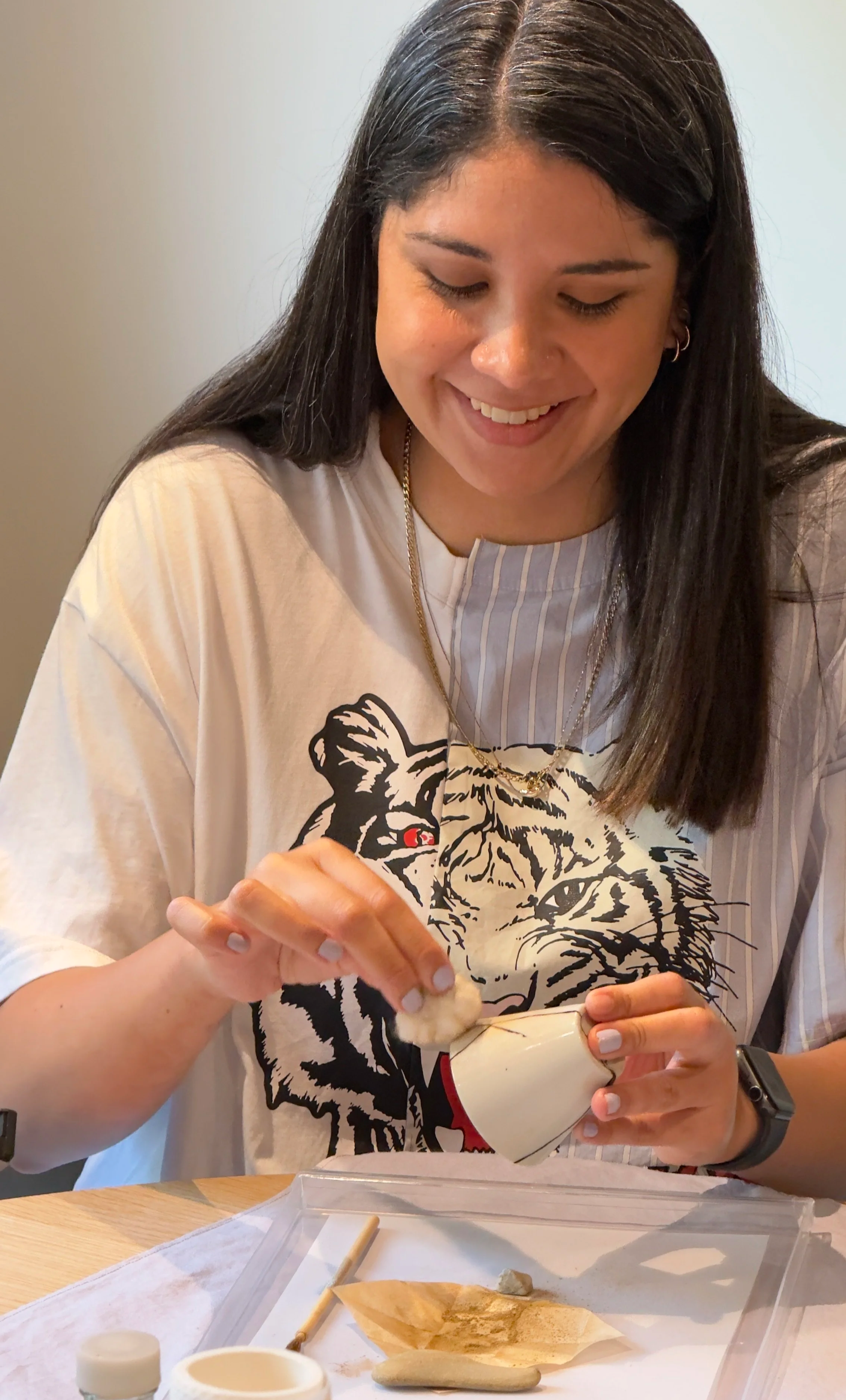
What Determines the Cost?
Materials, techniques, and the finish all influence the final price of a repair.
The biggest variant is the type of fracture: Because a fracture is never the same, even if it is broken in the same way every fracture is different and should be approached differently this is one of the spiritual approaches of kintsugi that I like to explain because even though sometimes pieces are broken in the same way the fracture will never be the same, like people.. every situation is different.
….some pieces only need to be reattached, while others also require reconstruction. Small ceramic pieces require more time because greater precision is needed. (A LOT TO CONSIDER!)
The cost of the repair also depends heavily on the materials used. One of the main materials is urushi, so the price can vary depending on how easily the artist can access it. It also depends on the type of finish for example, whether pure gold is used, the karat of the gold, the gilding technique, or whether the finish uses bronze instead of gold (a smart way to make the price more accesible if the piece is broken in several parts)
Another relevant variants is whether they are using natural materials, and whether the artist uses other types of adhesives with chemicals (which is not wrong but depends heavily on the price given).
An experienced artist may work “faster,” but this also means their hourly rate might be higher, reflecting their knowledge, the time they have invested in developing their skills, and their overall experience in the field.
So ultimately, the cost also depends on: the artist’s approach, the specific materials/techniques and size/type of the piece to repair and details of their fracture
Kintsugi is more than an art. It’s a philosophy.
My biggest recommendation would be to choose an artist who sees kintsugi that way, who takes the time to understand your piece before deciding how it should be repaired.
There are many different ways to approach a repair. If you’re not planning to use the piece for food or water, for example, there may be alternative materials or techniques that could work better. And depending on the material, the type of fracture, or how special or delicate the piece is, the repair may require more time, expertise, or a completely different approach.
That’s why I think one of the biggest green flags is when an artist wants to see the piece before giving you a price. It shows they’re taking the time to understand what the piece actually needs.
Every fracture is different. Every piece has its own story.
And that, to me, is what makes kintsugi so special :)
